Born in Graz: The Story of the Mercedes-Benz G-Wagon
How a mountain town in southern Austria built the most iconic off-roader on the planet, the Mercedes-Benz G-Class, and why its coordinates are on this hoodie.
Most cars are designed to change. Every few years they get a new shape, a new face, a new reason to trade in the old one. The Mercedes-Benz G-Wagon went the other way. More than four decades after the first one left the factory, you can still recognize a G-Wagon from a block away: the flat glass, the round headlights, the exposed door hinges, the spare tire hanging off the back. It is a box, and it is proud of it.
To understand why, you have to go to Graz.
A Mercedes built for the mountains
The G-Wagon's full name, Geländewagen, is German for "cross-country vehicle," and that is exactly what Mercedes-Benz meant it to be. In 1972, Daimler-Benz teamed up with the Austrian engineering firm Steyr-Daimler-Puch in Graz to develop a tough, go-anywhere four-wheel-drive. Three years later the two companies committed to series production and built a brand-new plant in Graz to make it.
On February 1, 1979, the first production Mercedes-Benz G-Class rolled off the line. It was built largely by hand, and remarkably, the G-Wagon still is. In a few countries, including Austria and Switzerland, the very same truck was even sold under the Puch name until the end of the 1990s.
The mountain that approves every G-Wagon
Just north of Graz rises the Schöckl, a 1,445-meter mountain that has become the G-Wagon's private proving ground. Its 5.6-kilometer test track climbs gradients of up to 60 percent and leans the truck over side slopes of up to 40 percent. Every new generation of the Mercedes G-Class has to log thousands of kilometers on it before it is allowed into production. Off-road fans call it the G-Wagon's version of the Nürburgring.
That is the real secret of the G-Wagon. It was never a luxury SUV that learned to go off-road. It was an off-roader, tested on a mountain, that later became the most famous luxury SUV in the world.
From military workhorse to Hollywood icon
The G started life in uniform, serving armies and border patrols around the world. Over time the Mercedes G-Wagon moved from the battlefield to the boulevard. Today a G-Wagon is just as likely to be parked outside a Beverly Hills restaurant or cruising the Pacific Coast Highway as it is to be climbing a rocky trail, and it looks equally at home in all of them.
The numbers tell the story. More than 200,000 G-Wagons had been built in Graz by the G's 30th birthday in 2009. The 300,000th followed in 2017, and in 2023 the 500,000th Mercedes-Benz G-Class came off the line in Graz. The G-Class is the longest-produced passenger car in Mercedes-Benz history.
The G-Wagon goes electric
Even an icon has to evolve. The newest chapter is the all-electric Mercedes-Benz G 580, which puts a separate electric motor at each wheel. That setup unlocks a party trick no gas-powered G-Wagon could ever pull off: the G-Turn, where the wheels on one side spin forward while the other side spins backward, letting the truck rotate on the spot. The electric G-Class is still built in Graz, and it still has to conquer the Schöckl.
Why Graz is on this hoodie
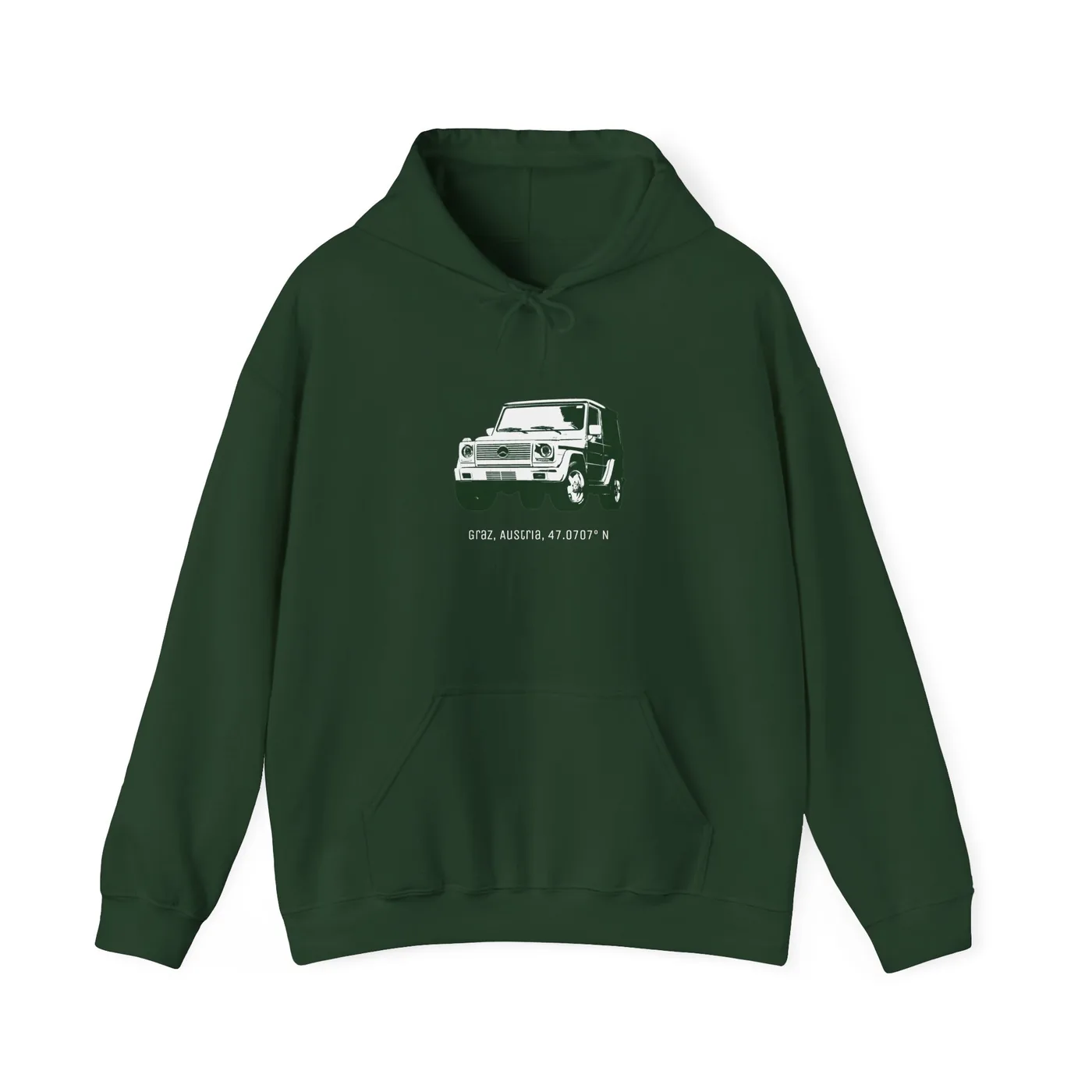
Every Mercedes-Benz G-Wagon in the world, from the first one in 1979 to the electric G rolling out today, traces back to one place. The coordinates on this G-Wagon hoodie point to Graz, Austria: the birthplace of the G.
No loud logos, no flash. Just a quiet detail for people who know exactly where the legend comes from. If you know, you know.
Wear the birthplace of the G
The Mercedes-Benz G-Wagon Hoodie in forest green, sizes XS–XXL, $44.
Back to the hoodie